Call us now :08045802065
 Send Inquiry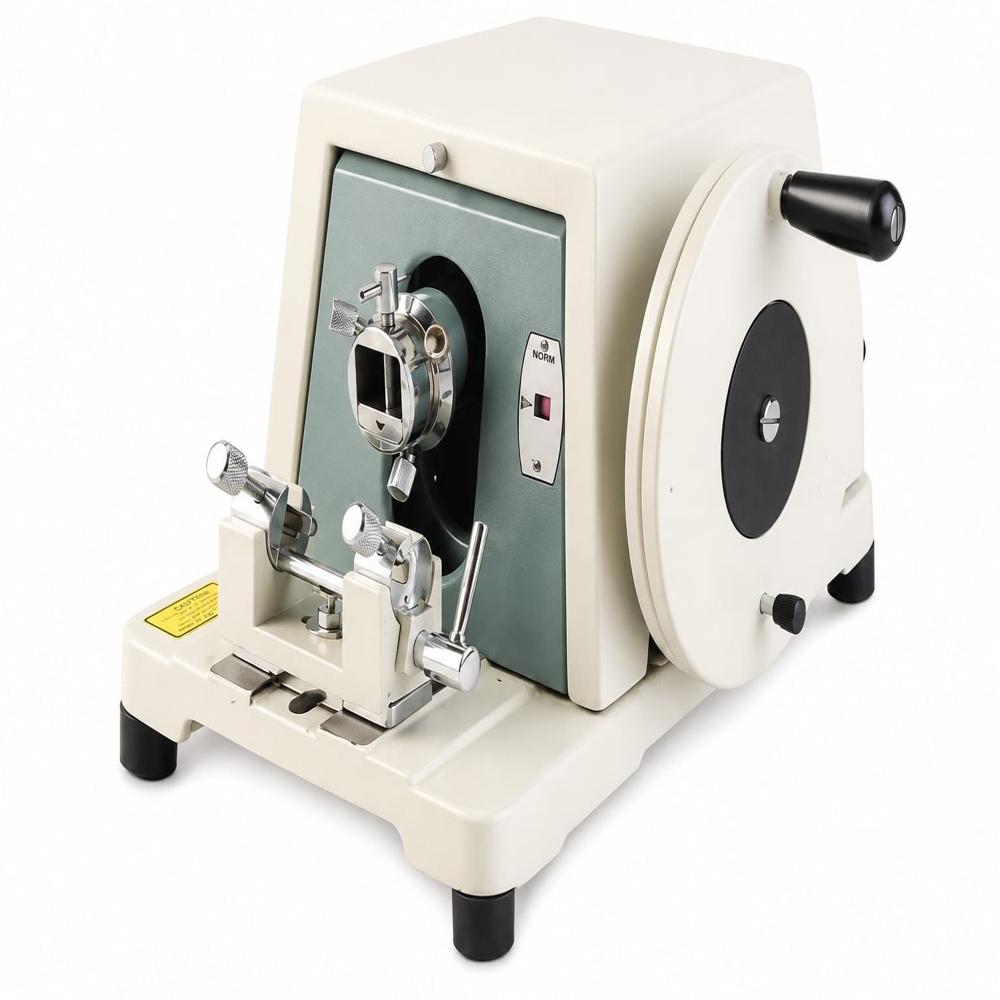
Spencer Rotary Microtome
28000 INR/Piece
Product Details:
- Control Type Manual Control
- Accuracy Up to 1 micron mm
- Glass Type N/A (Not Glass-based)
- Features Precision Cutting, Heavy Base, Smooth Handle Movement, Long Service Life
- Temperature Resistance N/A
- Power Supply Not Required (Manual)
- Heating Capacity N/A Volt (V)
- Click to View more
X
Spencer Rotary Microtome Price And Quantity
- 28000 INR/Piece
- 1 Piece
Spencer Rotary Microtome Product Specifications
- 17 Centimeter (cm)
- Histological Sectioning and Pathology Laboratory
- Not Required (Manual)
- brass alluminium steel casting iron
- 27KG Kilograms (kg)
- N/A Volt (v)
- 18 Centimeter (cm)
- for cutting tissue sections
- N/A Volt (v)
- Rectangular
- Manual, Adjustable by User
- N/A
- N/A Volt (V)
- N/A (Not Glass-based)
- N/A Kilogram(Kg)
- spencer type microtome
- Other
- Up to 1 micron mm
- Heavy-duty metal body with corrosion-resistant coating
- 18x25x17cm
- 18x25x17cm Centimeter (cm)
- Manual Control
- 25 Centimeter (cm)
- N/A
- white and black
- Precision Cutting, Heavy Base, Smooth Handle Movement, Long Service Life
- Senior Precision Rotary Microtome
- 2 years
- 1 micron
- Cam-operated Rotary System with Ball Bearings
- 1-25 microns (readable in 1-micron increments)
- Approx. 120 mm
- Powder Coated Enamel
- For Routine and Research Microtomy Tasks
- Complete with Object Holders, Knife, Honing Stone, and Dust Cover
- Universal with Safety Lock and Finger Guard
- Maximum up to 22 x 22 mm
- Included for Various Tissue Blocks
- Approx. 28 kg
Spencer Rotary Microtome Trade Information
- Ambala Cantt
- Cheque
- 4 Days
- Contact us for information regarding our sample policy
- Middle East, Africa, Asia, Australia, Central America, North America, South America, Eastern Europe, Western Europe
- All India
Product Description
Senior Precision Rotary Microtome ( Spencer 320 Type) which we trade, supply, export and manufacture is used for precise sectioning of tissues up to the thickness of 1 micron. Its interior mechanism rests on a heavy cast iron base that is covered with a full swing protective cover for easy cleaning and lubrication. Senior Precision Rotary Microtome (latest Spencer 320 Type) is known for independent feed mechanism with automatic safety device, universal knife holder with lateral movements permitting use of the entire knife edge and universal vice type object holder for accurate centering of the specimen . It is fabricated using fine grain steel tested for micro-structure, heat treated for optimum rigidity and sharpness and has a long service life.
Highly Accurate Sectioning for Research and Diagnostics
Designed for both routine and research applications, the Senior Precision Rotary Microtome delivers precision tissue sections with adjustable thickness from 1 to 25 microns. The manual cam-operated mechanism ensures consistent, reliable performance ideal for detailed histological and pathology examinations. Its heavy-duty plan provides stable operation, minimizing vibration and maximizing section quality.
User-Centric Design with Universal Compatibility
Featuring a universal clamp and object holders, this microtome accommodates various tissue blocks up to 22 x 22 mm. The universal knife holder is equipped with a safety lock and finger guard for secure and user-friendly operation. Additional included accessories like the honing stone simplify knife maintenance, ensuring lasting sharpness and accuracy for every application.
FAQs of Senior Precision Rotary Microtome:
Q: How does the section thickness adjustment work on the Senior Precision Rotary Microtome?
A: The microtome allows users to set the section thickness ranging from 1 to 25 microns in 1-micron increments, ensuring high accuracy. The cam-operated rotary system, paired with precise feed adjustments, delivers consistent section thickness ideal for detailed histological analysis.Q: What types of laboratory applications is this microtome suitable for?
A: This microtome is designed specifically for histological sectioning in pathology laboratories. It supports both routine diagnosis and advanced research, enabling precise tissue preparation for various staining and microscopic examination protocols.Q: When should routine maintenance be performed on the microtome?
A: Routine maintenance, such as cleaning, lubricating moving parts, and honing the knife, should be performed after each use. This keeps the instrument in optimal condition, maintains sectioning accuracy, and extends the service life of both the blade and the microtome itself.Q: Where can this microtome be installed in a laboratory?
A: The instrument features compact dimensions (420 x 380 x 230 mm) and a stable base, making it suitable for placement on most laboratory benchtops. It does not require any electrical power supply, offering maximum flexibility in laboratory layout.Q: What is the process for changing specimens and blades?
A: The universal clamp allows quick and secure mounting or removal of specimen blocks up to 22 x 22 mm. Replacing blades is straightforward with the universal knife holder, which includes a safety lock and finger guard to protect users during the process.Q: How does the manual operation benefit the user?
A: Manual operation means no power supply is needed, making the microtome suitable for varied laboratory environments. It allows users to control section speed and rhythm, supporting delicate sectioning tasks and reducing the likelihood of mechanical error.Q: What are the main safety features of the precision rotary microtome?
A: Safety is enhanced through a universal knife holder with a dedicated safety lock and finger guard, preventing accidental hand contact with the blade during operation or blade changes. The sturdy construction and powder-coated finish also ensure operational safety and equipment longevity.Q: How do I adjust the section thickness on the Spencer Rotary Microtome?
A: The section thickness is easily set using the adjustable control, allowing increments from 1 to 50 microns. Simply adjust the control knob to your desired micron measurement prior to sectioning.Q: What is the process for operating the microtome during tissue sectioning?
A: Operation involves clamping the specimen in the universal holder, adjusting thickness, and turning the manual rotary hand-wheel to advance the specimen. The locking mechanism secures the handle during loading or between cuts.Q: When should the knife be honed on the Spencer Microtome?
A: Hone the knife regularly to maintain sharpness, especially if you notice thicker or uneven sections, or after extended use. The supplied honing stone allows for convenient maintenance.Q: Where can this microtome be used effectively?
A: This model is ideal for clinical, research, and educational laboratories that require high-precision sectioning of biological tissues for microscopic examination.Q: What benefits does the chemical-resistant powder coating provide?
A: The powder-coated finish ensures resilience against laboratory chemicals and prevents rust, enhancing durability and longevity even with frequent cleaning and use.Q: How does the lateral knife holder movement benefit sectioning?
A: Lateral movement allows the user to reposition the knife edge for even wear and hone different areas, improving sectioning quality and prolonging the knifes lifespan.Q: What are the advantages of manual operation in this microtome?
A: Manual operation provides full user control, eliminates dependency on external power, and offers smooth, precise cutting, making it reliable even in locations with unstable power supply .Tell us about your requirement

Price:
Quantity
Select Unit
- 50
- 100
- 200
- 250
- 500
- 1000+
Additional detail
Mobile number
Email

Other Products in 'Microtomy' category



 Send Inquiry
Our Products

4, Vikaspuri Near Industrial Area, Sai Mandir Road, Ambala Cantt,Ambala Cantt - 133006, Haryana, India

Mr S. K Saini
(M.D)
Mobile :08045802065
 Send Inquiry
 Send SMS
Developed and Managed by Infocom Network Private Limited.
